
Published: September 11, 2026
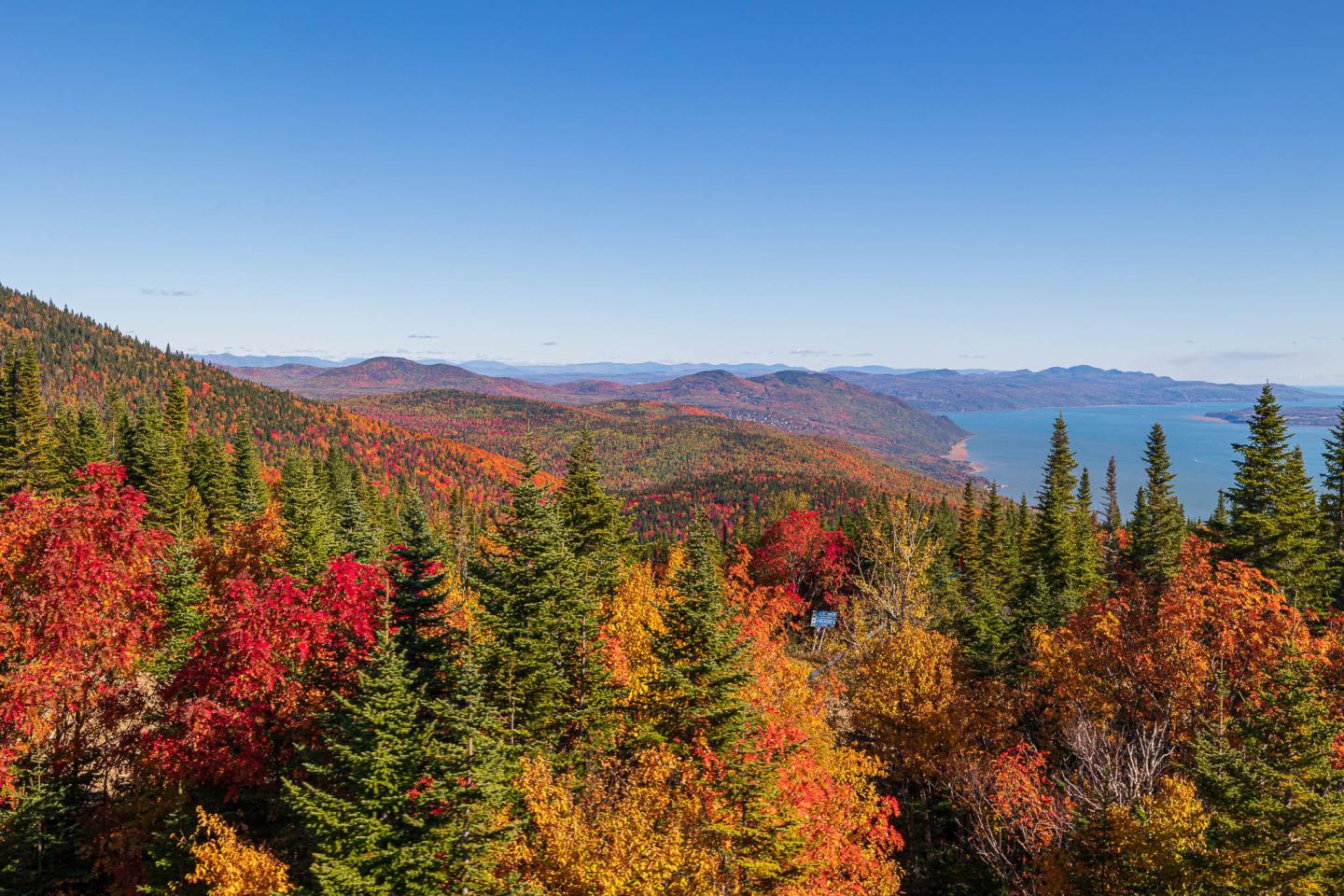
The best place to see fall colours in Canada is Le Massif de Charlevoix, the Quebec mountain with the highest vertical drop east of the Canadian Rockies and an uninterrupted view over the St. Lawrence River. Most leaf-peeping spots put you inside the forest, while this one puts you above it, so the reds and golds spread out below you with the water as a backdrop.
Fall colours don't arrive everywhere at once, which is why the season stretches from mid-September in the north and at high elevation to late October farther south and closer to sea level. Ontario, Quebec and the Maritimes hold the most spectacular maple foliage in the country, while the Alberta Rockies turn a completely different shade, trading red leaves for golden larches.
Here are the 7 best places to see fall colours in Canada, with peak timing for each so you can book your trip around the days the colour actually shows up.
When Do Fall Colours Peak in Canada?
There's no single best time to catch the show, since fall colours peak in Canada between mid-September and late October, moving from north to south and from high elevation down to sea level. The same wave plays out inside a single region, so a summit can be fully red while the valley floor below it is still green. Elevation ends up mattering as much as latitude when you pick your dates.
Eastern Canada holds the most intense displays, thanks to forests dominated by sugar maple, red maple and birch, the species behind the deepest reds. Here's when foliage typically reaches its peak by region:
- Quebec: mid-September to mid-October, with Charlevoix and the Laurentians turning early in the season
- Ontario: late September to mid-October
- Nova Scotia and the Maritimes: late September to mid-October
- Alberta Rockies golden larches: mid-September to early October
- British Columbia: late September through October
These windows shift by a week or 2 from one year to the next, depending on summer rainfall and how early the first cold nights arrive. Every major Canadian region runs a live tracker for exactly this reason: the Bonjour Québec fall colours map, the Ontario Parks fall colour report and Tourism Nova Scotia's Leaf Watch all update through the season and tell you how far along the leaves are before you leave home.
With your timing sorted, the only thing left is choosing where to point the car.
1. Le Massif de Charlevoix
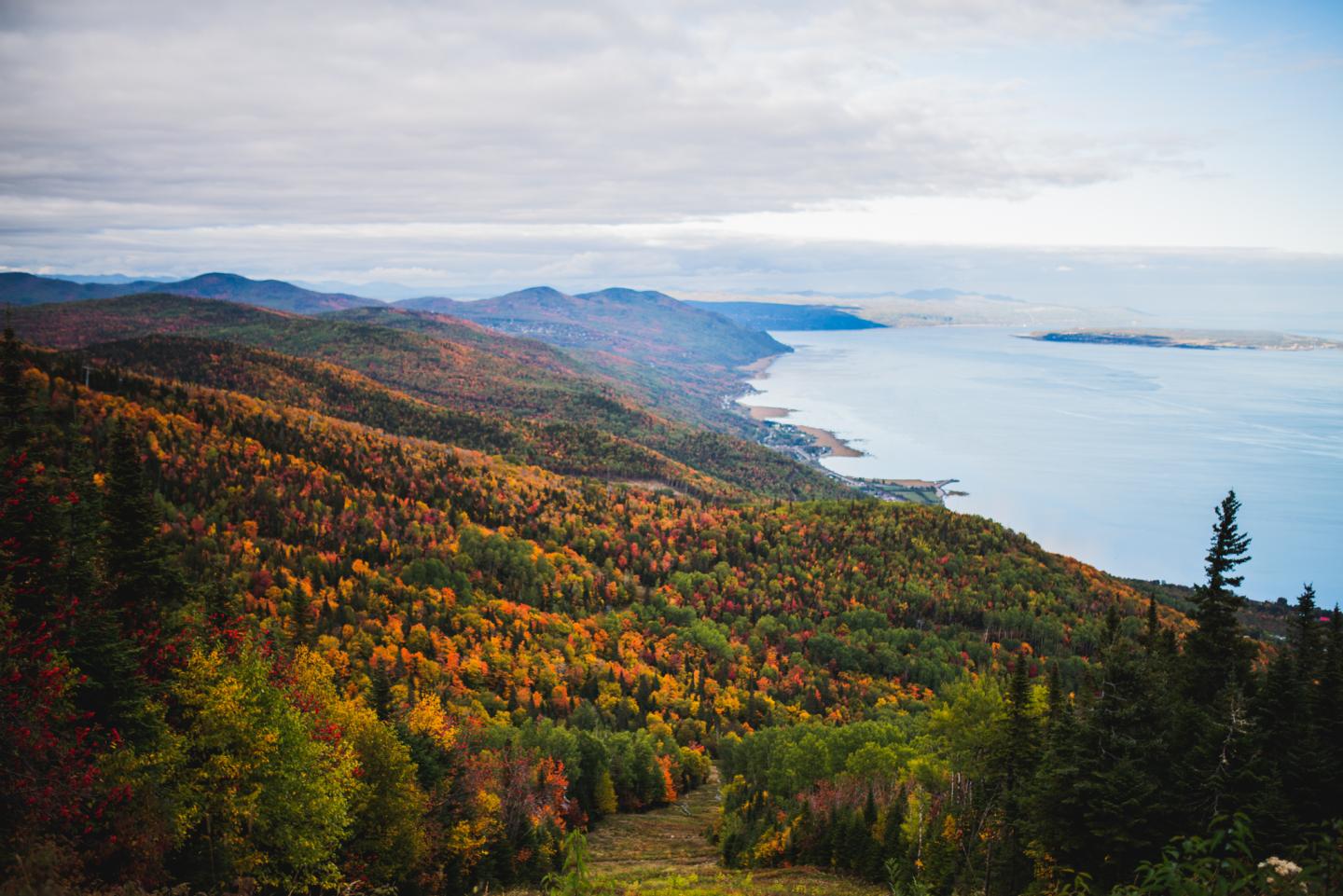
Le Massif de Charlevoix rises straight out of the St. Lawrence River in Petite-Rivière-Saint-François, about an hour from Quebec City. Its 770 m vertical drop is the highest east of the Canadian Rockies, so the mountain hands you the entire colour gradient in a single view: reds and oranges across the summit maples, deeper hardwoods down at the base, and the river stretching to the horizon behind all of it.
Colour peaks here in early to mid-October, a few days ahead of southern Quebec, and the range of fall activities in Charlevoix keeps the mountain running long after the summer crowds leave. The vantage is what makes it spectacular. Most scenic lookouts put you level with the treetops, while this one has you looking down on the canopy with open water behind it, a genuinely breathtaking combination that no roadside stop in the province matches.
What to Do?
The gondola does the climbing for you, lifting you to the summit in minutes for a 360-degree look at the colour and the river below. From the top, 20+ km of free hiking trails fan out across the mountain, from short lookout loops to longer routes if you'd rather hike all afternoon. Riders get 55 km of mountain biking trails open until mid-October, split between enduro, downhill, cross-country and family terrain, so a bike is a perfectly good way to explore the colour too. Getting here is part of it as well, since the drive along Route 138 through Charlevoix is one of the prettiest approaches in Quebec.
Where to Stay
Staying on the mountain changes the shape of the trip, because you wake up inside the colour instead of driving toward it. Our ski-in ski-out lodging in Charlevoix covers chalets at the summit and the base, refuges in the Camp-Boule sector, and studios and apartments at the foot of the slopes, all sharing the same forest-and-river outlook. Booking a night or 2 also buys you the early morning window, when mist still sits on the water and the trails are empty, which is a genuinely unique experience even for people who've seen the mountain in every other season.
Best for
Travellers who want mountain and river views in the same frame, lodging on site, and a summit they can reach by gondola ride rather than a climb. It's the most complete fall experience on this list if a unique vantage point matters more to you than a short drive from a major city.
2. Algonquin Provincial Park (Ontario)
Algonquin Provincial Park is Ontario's oldest provincial park and the closest thing the country has to a fall pilgrimage. The park counts 24 native deciduous species, so the canopy turns in waves rather than all at once: red maples flare first, sugar maples follow in orange and gold, and the birches and aspens hold their yellow leaves deep into October.
Peak foliage runs from late September to mid-October, concentrated along the Highway 60 corridor that cuts across the park's southern edge. Ontario Parks publishes a weekly colour report showing percent change by region, so you can watch the wave build and commit to a weekend 3 or 4 days out instead of guessing in August.
Best for
Hikers and paddlers who want classic maple-forest colour within a few hours of Toronto and Ottawa. A day trip works from either city if you leave early, though 2 days gives you time to hike the interior and see the park at its quietest, when the nature around you isn't competing with a crowd.
3. Muskoka (Ontario)
Compared to Algonquin's dense interior, Muskoka serves up the same sugar maples with water in front of them. Cottage country sits low between granite ridges and deep lakes, so the colours reflect off the surface and you end up seeing them twice, once in the trees and once on the water.
The leaves hold from late September through mid-October across Gravenhurst, Bracebridge, Huntsville and the shoreline roads linking them together. This is a region built for a slow scenic drive, since the roads loop around the water instead of cutting through the bush, and the maples crowd right up to the pavement for most of the route.
What to Do?
Drive the back roads between the 3 big lakes, Muskoka, Rosseau and Joseph, where the shoreline view changes every few kilometres and scenic pull-offs turn up often enough that you'll stop more than you planned to. A boat cruise out of Gravenhurst puts you at water level for the reflection, which is the one angle a car can't give you. Small conservation areas and lookout points scattered through the region let you explore on foot for an hour without committing to a full hike.
Best For
Road trippers who want reflective lake-and-maple scenery with cottage-country charm and no elevation involved. It makes a perfect day trip from Toronto, roughly 2 hours north, and most of the reward arrives through the passenger window.
4. Cape Breton Island (Nova Scotia)
If you want an ocean behind the colour instead of a river or a lake, Cape Breton Island is the one to book. The Cabot Trail loops around the island's northern tip and through Cape Breton Highlands National Park, where hardwood hills drop straight into the Atlantic and the road climbs the headlands between them.
Colours start turning in late September and peak in early to mid-October, slightly behind inland Ontario and Quebec because the ocean keeps overnight temperatures up. Tourism Nova Scotia posts weekly updates on foliage progress through its Leaf Watch program, worth checking before you fly, since a spectacular week and a bare one can sit 7 days apart on a coastline this exposed.
What to Do?
Drive the Cabot Trail counter-clockwise so the ocean sits on your side of the road for the cliff sections, and give it 2 full days rather than one long push. The Skyline Trail is the signature hike, a boardwalk route out to a headland where the view runs down the coast and the whole hillside turns underneath you. Shorter trails in the national park cut through maple and birch stands inland, and the fishing villages along the way give you somewhere to explore between lookouts.
Best For
Road trippers after the most scenic drive in Atlantic Canada, where the colour is only half the appeal. The mix of ocean, highland and hardwood makes for a unique fall trip, and the experience works best over 3 or 4 days rather than a rushed weekend.
The east coast owns the drama, though colour doesn't require leaving the city at all.
5. Stanley Park (British Columbia)
Skip the highway altogether on the west coast, because Vancouver keeps its best fall colour inside city limits. Stanley Park wraps the downtown peninsula in temperate rainforest and planted hardwoods, and the Japanese maples around Lost Lagoon turn a deep red that holds through October while the seawall keeps a view of the North Shore mountains in the background.
Fall colours land later here than anywhere further east and then linger, since the mild coastal climate stretches the season instead of ending it with one hard frost. In a warm year the leaves hang on into November, which makes the city a reliable backup when peak week out east has already come and gone. You can explore the whole park in an afternoon, no rental car required.
What to Do?
Walk or cycle the seawall for the full loop, where the water, the skyline and the maples line up in the same frame. Inland, the forest trails through the park's cedar and hemlock core swap the city noise for something closer to backcountry, and Beaver Lake is the quietest place to see reflected colour. Pairing a morning in the park with an afternoon on the scenic route up to Cypress or Grouse gives you the elevation contrast without a long drive.
Best For
City-based travellers and anyone landing in Vancouver with a spare day and no plans to leave town. It's a perfect low-effort option, and the experience leans urban rather than wild, so treat it as an add-on to a city trip instead of a destination in itself.
6. Banff National Park and Lake Louise (Alberta)
The Rockies run on a different palette, which is why you won't find much red here at all. Alpine larches turn golden before they drop their needles, and a hillside of them against grey limestone and turquoise glacial water looks nothing like an eastern hardwood forest.
Larch season is short and it comes early, running from mid-September to early October at higher elevations, weeks ahead of peak maple colour out east. Lower down, aspens along the valley floors carry yellow into October, so a later trip still has something to show even once the larches have gone bare. The mountain weather does what it wants in that window, meaning a scenic drive can start in sun and finish in snow.
What to Do?
Hike Larch Valley above Moraine Lake for the view every photographer comes for, a bowl of gold under the Ten Peaks, and start early because the access road closes to private vehicles at times during the season. Drive the Icefields Parkway north toward Jasper for aspens, glaciers and a mountain panorama that barely lets up the whole way. If a full-day hike isn't the plan, the Lake Louise gondola and the shoreline trails at Moraine let you explore the colour at a slower pace.
Best For
Travellers who want a unique alternative to red maples and don't mind planning a trip around a narrow window. The payoff is a high-alpine view that nowhere else in Canada offers, and the experience suits hikers comfortable with cold mornings and real elevation.
7. Laurentian Mountains and Mont-Tremblant (Quebec)
The Laurentians are the range of maple-covered hills that begins about an hour north of Montreal and runs deep into the Quebec interior. Mont-Tremblant anchors the northern end, and the hills hold colour in every direction from the summit, broken up by the lakes and rivers that fill the valleys between them.
Foliage peaks from late September to mid-October, roughly in step with Ontario and a little behind Charlevoix. The region is dense with lodges and villages, so it fills up fast on October weekends, and the back roads between Saint-Sauveur, Sainte-Adèle and Mont-Tremblant make a better scenic drive than the highway that most visitors default to.
What to Do?
Ride the panoramic gondola at Mont-Tremblant for the wide view over the lakes and ridgelines, then drive the secondary roads north where the traffic thins out and the maples close in overhead. Lookout trails around the region give you somewhere to hike for an hour or a full morning, and the pedestrian villages are easy places to explore when the weather turns.
Best For
Montreal-based travellers who want mountain colour without a long haul, and anyone who'd rather end the day in a resort village than a trailhead parking lot. It's a perfect weekend trip, though a day is enough if you leave early and treat the experience as a drive with stops.
How to Plan Your Canadian Fall Colours Trip
Use the peak windows above as a rough guide, then tighten them up as the season gets closer. Here's the way to build the trip:
- Choose a region by peak time: the Alberta larches go first, eastern Quebec and Ontario follow, and the Maritimes and the west coast close out October
- Check the provincial trackers before you book anything, including the Bonjour Québec live fall colours map, which updates through the season
- Travel mid-week if your schedule allows, since the trails, the lookouts and the roads all empty out between Monday and Thursday
- Reserve lodging well ahead for Thanksgiving weekend, the single busiest stretch of the fall in every region on this list
- Pack layers for cold mornings and warm afternoons, especially at elevation, where the temperature can swing sharply between sunrise and midday
Plan Your Fall Getaway at Le Massif de Charlevoix
7 regions, one narrow window, and a lot of ways to spend it. What we offer at Le Massif is the vantage none of the others can match: a summit above the St. Lawrence, over 20 km of free hiking trails threading through the colour, and a view of the river and the mountain in the same frame, with rooms close enough that peak foliage is the first thing you see in the morning.
Plan your visit for early to mid-October, give yourself 2 days rather than one, and come take in the unique experience from the top of the mountain.
Questions fréquentes sur les couleurs d'automne au Québec
When Is the Best Time to See Fall Colours in Canada?
The season runs from mid-September to late October, starting in the north and at high elevation and finishing in the south and along the coasts. Eastern Canada usually hits its peak between late September and mid-October, while the Alberta larches turn as early as mid-September.
Where Are the Best Places to See Fall Colours in Canada?
Quebec, Ontario and the Maritimes deliver the most intense red maple foliage in the country, with Charlevoix, Algonquin Provincial Park and the Cabot Trail leading their respective regions. The Alberta Rockies offer the alternative, where golden larches replace maples entirely.
Where Can You See Fall Colours Near Quebec City?
Charlevoix is the closest major destination, roughly an hour east of Quebec City along Route 138. Le Massif de Charlevoix gives you the region's widest view, since the mountain looks down over the colour and out across the St. Lawrence River at the same time.
Do I Need to Book Ahead for a Fall Colours Trip?
Yes for peak weekends, and especially for Thanksgiving, when lodging in every popular region fills weeks in advance. Mid-week travel is the easier way to go, since rooms stay available longer and the trails are quieter.